Leading Responsibly in Times of Disruption

Interconnected World of Thinkers and Doers
Call to participate in a research project as part of an executive Doctorate in Business Administration (DBA) in Swiss School of Business Management by Khulan Berger in collaboration with Caux Initiatives of Change - “Building Trust Across World’s Divides” and Chemin28 - “Building trust for leadership that serves life”. This research is dedicated to understanding from Business Leaders mainly from SMEs in Switzerland but also case studies from Mongolia, Singapore and Belgium on how leadership development and multi‑stakeholder initiatives shape responsible and resilient leadership in times of systemic disruption.
How to participate
You can choose one or both of the following:
1. Semi-structured Interview (recommended)
A 45–60 minute online interview (Zoom/Teams) at a time that suits you
We go deeper into your experiences, examples and reflections as an SME leader, NGO/foundation representative or corporate leader working with SMEs,
You can review a short summary of findings later if you wish.
2. Complete an online questionnaire(button below)
Approximately 18 open questions,
Takes about 20–30 minutes,
You can respond at your own pace.
Why this research now
Today’s SME leaders are operating in what many describe as a “polycrisis” of overlapping disruptions, from AI and digitalisation to supply‑chain shocks, geopolitical tensions and tightening sustainability and ESG expectations (ClearSky2100, 2025; Harris, 2025; United Nations Global Compact, 2025). Traditional leadership models and one‑size‑fits‑all training programmes increasingly struggle to address this complexity (Agile Academy, 2024; Centre for Creative Leadership, 2025; IMD Business School, 2017).
At the same time, new approaches are emerging: multi‑stakeholder initiatives like those hosted in Caux, resilience and mental‑fitness programmes, Inner Development Goals‑inspired work, and purpose‑driven movements such as B Lab (B Lab, 2024; IMD, 2024; Mannaz, 2024; Resilience Institute, 2025). However, we still know little about how these actually change how SME leaders think, decide and act in real organisational contexts (Emerald Publishing, 2025; EM Strasbourg Business School, 2024; Vo, 2011).
This research explores how SME leaders develop “responsible–resilient” leadership in times of systemic disruption, and what truly helps (or does not) in practice .
What the study is about
Developing Responsible Leadership in Times of Systemic Disruption: Evaluating Multi‑Stakeholder Leadership InitiativesThis study focuses on:
SME leaders in Switzerland as the core focus, with contrasting cases from Mongolia, Singapore and Belgium
How you lead through systemic disruptions such as digitalisation, regulatory change, sustainability pressures, crises and market shocks
How you understand and practise responsible leadership – balancing performance with responsibilities to employees, communities, partners and the wider system
The role of leadership, resilience and inner‑development programmes, multi‑stakeholder dialogues and business networks and what you learn informally through experience
Who is invited to participate
We are inviting:
Senior leaders of SMEs based in Switzerland, Mongolia, Singapore or Belgium.
Both leaders who have taken part in leadership, resilience or multi‑stakeholder initiatives and leaders who have not; perspectives from both groups are crucial for comparison
In addition, a small number of NGO/foundation representatives and leaders from larger companies will be invited as key informants to share ecosystem perspectives on SME leadership and multi‑stakeholder collaboration
You do not need to use any particular terminology or framework – your own words and stories are what matter most.
Benefits of participation
By taking part,
Have a structured opportunity to reflect on how you lead through disruption, what has shaped you, and where you want to go next
Contribute to practical insights for designing leadership and resilience programmes that truly work for SME leaders, rather than copying large‑corporate models
Help organisations like Caux Initiatives of Change as well as business networks and educators, rethink how they support leaders who carry significant responsibility with fewer resources than big firms
Receive (if you opt in) a short summary of key findings and design principles for responsible and resilient SME leadership, which you can use in your own business or networks
Thank you very much for your valuable time and expertise!
Deeply appreciated by yours truly,
Khulan Berger
-
Agile Academy. (2024, December 9). Leadership strategies for times of disruption. Agile Academy. https://www.agile-academy.com/en/agile-leader/leadership-strategies-for-times-of-disruption/
B Lab. (2024). Business as a force for good: Leadership and systems transformation. B Lab Global. https://www.bcorporation.net
Centre for Creative Leadership. (2025, July 28). Leadership in disruption: Adaptability in perpetual crisis. Centre for Creative Leadership. https://www.ccl.org/guides/perpetual-crisis-leadership-in-disruption/
ClearSky2100. (2025, May 18). Global risks 2025: Business implications of polycrisis. ClearSky2100. https://clearsky2100.com/navigating-the-polycrisis-global-risks-and-business-implications-in-2025/
EM Strasbourg Business School. (2024, September 30). Cluster RESPONS: Responsible leadership in practice(s). EM Strasbourg Business School. https://www.em-strasbourg.com/en/respons-responsible-leadership-practices
Emerald Publishing. (2025). Responsible leadership: A systematic literature review. Journal of Business Research. Advance online publication. https://www.sciencedirect.com/science/article/pii/S0148296325006241
Harris, J. (2025, May 19). How small businesses can navigate global trade in an era of polycrisis. World Economic Forum. https://www.weforum.org/stories/2025/05/small-businesses-msmes-global-trade-polycrisis/
Hyett, N., Kenny, A., & Dickson‑Swift, V. (2014). Methodology or method? A critical review of qualitative case study guidelines. The Qualitative Report, 19(38), 1–18. https://nsuworks.nova.edu/cgi/viewcontent.cgi?article=1008&context=tqr
IMD. (2024, September 22). Leaders need inner development to reach the SDGs. I by IMD. https://www.imd.org/ibyimd/sustainability/leaders-need-inner-development-to-reach-the-sdgs/
IMD Business School. (2017, March 22). How disruption is redefining leadership. IMD. https://www.imd.org/research-knowledge/technology-management/articles/how-disruption-is-redefining-leadership/
Insight7. (2024, December 17). How to use maximum variation sampling in qualitative studies. Insight7. https://insight7.io/how-to-use-maximum-variation-sampling-in-qualitative-studies/
Mannaz. (2024, December 17). Jump into 2025 with the Inner Development Goals – That’s my New Year’s wish. Mannaz. https://www.mannaz.com/en/articles/change-transformation/jump-into-2025-with-the-inner-development-goals-thats-my-new-years-wish/
Morse, J. M. (2023). Refinement pathway for quality research interview guides: An 8‑step process to refine a protocol. Journal of Global Health Reports, 7, e2023054. https://www.joghr.org/article/87858-refinement-pathway-for-quality-research-interview-guides-an-8-step-process-to-refine-a-protocol
OECD. (2025, November 10). Unleashing SME potential to scale up: Scalers as drivers of competitiveness. OECD. https://www.oecd.org/en/publications/unleashing-sme-potential-to-scale-up_ea948a58-en/
Palinkas, L. A., Horwitz, S. M., Green, C. A., Wisdom, J. P., Duan, N., & Hoagwood, K. (2015). Purposeful sampling for qualitative data collection and analysis in mixed method implementation research. Administration and Policy in Mental Health and Mental Health Services Research, 42(5), 533–544. https://pmc.ncbi.nlm.nih.gov/articles/PMC4012002/
Resilience Institute. (2025). Global resilience report 2025: Fit for change. Resilience Institute. https://resiliencei.com/resources/research/2025-global-resilience-report/
Samson‑Velhe, J. (2025, January 21). The silent crisis: What the data really tells us about SMEs in 2024. LinkedIn. https://www.linkedin.com/pulse/silent-crisis-what-data-really-tells-us-sme-2024-jane-samson-velhe
Tong, A., Sainsbury, P., & Craig, J. (2016). Developing a framework for a qualitative semi‑structured interview guide. BMJ Open, 6(5), e010643. https://pubmed.ncbi.nlm.nih.gov/27221824/
United Nations Global Compact. (2025, January 28). Five takeaways from the 2025 World Economic Forum. UN Global Compact. https://unglobalcompact.org/compactjournal/five-takeaways-2025-world-economic-forum
Vo, L.‑C. (2011). Corporate social responsibility and SMEs: A literature review and agenda for future research. Problems and Perspectives in Management, 9(4), 89–97. https://www.businessperspectives.org/images/pdf/applications/publishing/templates/article/assets/4308/PPM_2011_04_Vo.pdf
A Step Further: Immerse Yourself in a transformative 48-hour experience
Don't miss this exceptional gathering ‘Leading with humanity in the age of artificial intelligence with Chemin 28 and the Caux Initiatives and Change Foundation, this event will bring together leaders, innovators, decision-makers and experts to imagine a future where AI amplifies human potential rather than replacing it. Three days of inspiration, conferences, experiential practices and authentic exchanges to reinvent leadership in the age of emerging technologies.
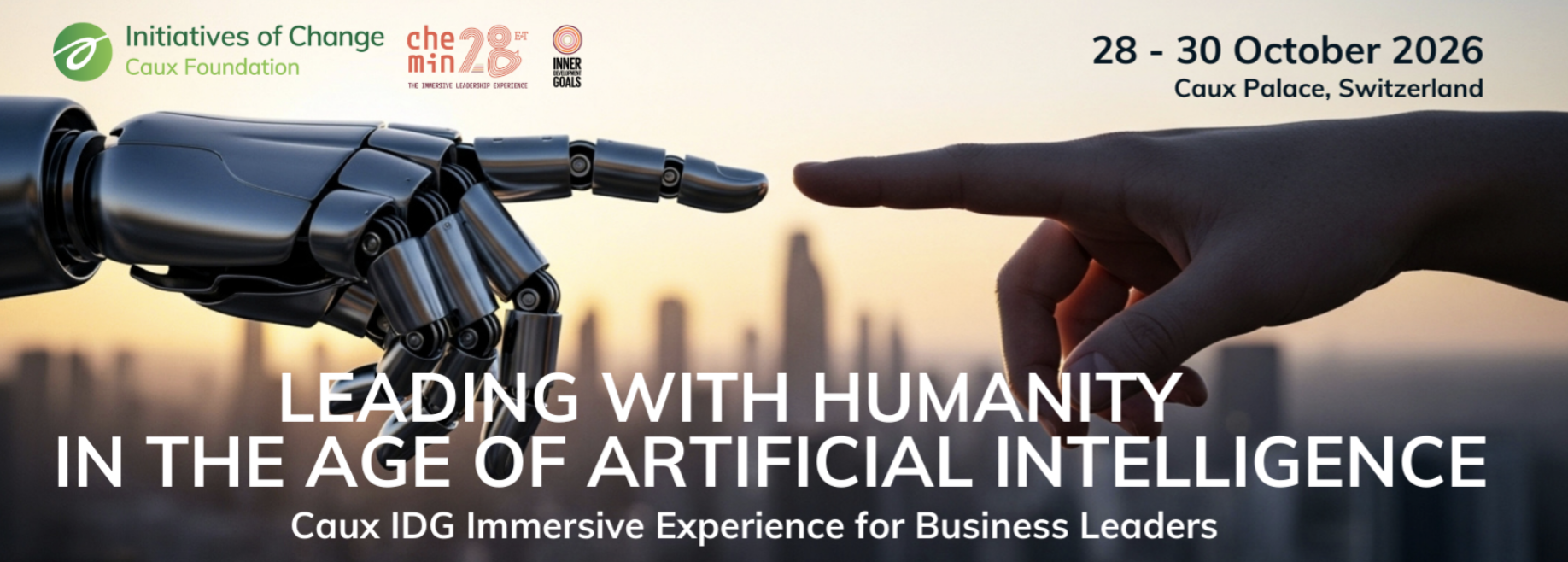
28 - 30 Octover 2026, Caux Palace - https://www.iofc.ch/lead-with-humanity-ai
As artificial intelligence redefines our societies at an unprecedented rate, an urgent need is emerging: for leaders capable of wisdom, empathy and courageous imagination. This immersion has been designed as a true catalyst for inner transformation, organisational clarity and collective renewal.
Immersed in a magnificent natural setting, participants will explore how to accompany technological transitions in a fully conscious, democratic and life-centred way and aligned with the Inner Development Guide (IDG)– the international framework of inner competencies for sustainable transformation.
This is a unique opportunity to get ahead of the curve — and actively contribute to the profound transformation that lies ahead.